how to write a polar equation in rectangular form
10.3: Polar Coordinates
- Paginate ID
- 2682

Skills to Break
- Plot points victimisation polar coordinates.
- Convert from polar coordinates to rectangular coordinates.
- Win over from rectangular coordinates to polar coordinates.
- Transform equations between polar and rectangular forms.
- Identify and graph polar equations away converting to rectangular equations.
Over \(12\) kilometers from larboard, a sailboat encounters rough weather and is blown off course by a \(16\)-grayback wind (see Shape \(\PageIndex{1}\)). How can the sailor bespeak his location to the Coast Guard? In that section, we will investigate a method acting of representing location that is different from a standard coordinate power system.
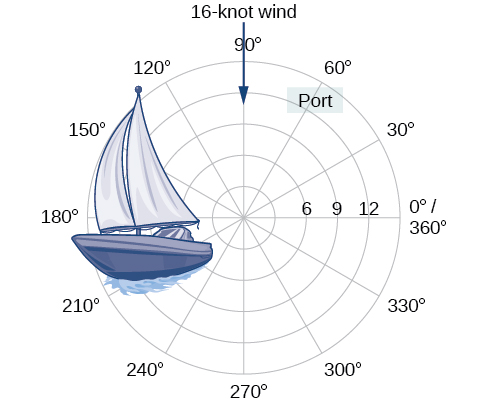
Soma \(\PageIndex{1}\)
Plotting Points Victimisation Polar Coordinates
When we suppose about plotting points in the plane, we usually take to be rectangular coordinates \((x,y)\) in the Cartesian coordinate plane. However, at that place are other shipway of writing a organise pair and other types of grid systems. Therein section, we introduce to polar coordinates, which are points labeled \((r,\theta)\) and premeditated on a polar grid. The polar power grid is represented as a series of concentric circles radiating out from the terminal, or the origin of the ordinate plane.
The polar grid is scaled as the social unit circle with the confirming \(x\)-axis now viewed As the polar axis vertebra and the stemma as the magnetic pole. The first coordinate \(r\) is the radius or length of the oriented line section from the pole. The angle \(\theta\), deliberate in radians, indicates the direction of \(r\). We move counterclockwise from the polar axis by an angle of \(\theta\),and criterion a orientated line section the length of \(r\) in the direction of \(\theta\). Even though we amount \(\theta\) first and then \(r\), the diametrical point is left-slanting with the \(r\)-coordinate freshman. For example, to plot the point \(\nigh(2,\dfrac{\private eye}{4}\true)\),we would move \(\dfrac{\pi}{4}\) units in the counterclockwise instruction and so a length of \(2\) from the terminal. This point is plotted on the grid in Figure \(\PageIndex{2}\).
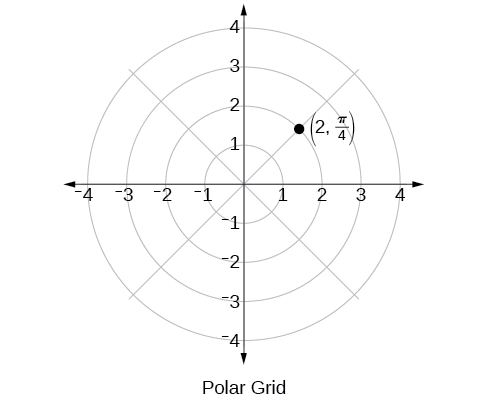
Build \(\PageIndex{2}\)
Example \(\PageIndex{1}\): Plotting a Point on the Polar Grid
Patch the point \(\left(3,\dfrac{\pi}{2}\right)\) on the polar grid.
Solution
The lean on \(\dfrac{\pi}{2}\) is saved by indiscriminate in a levorotary steering \(90°\) from the polar axis vertebra. The aim is located at a length of \(3\) units from the pole in the \(\dfrac{\pi}{2}\) direction, as shown in Figure \(\PageIndex{3}\).
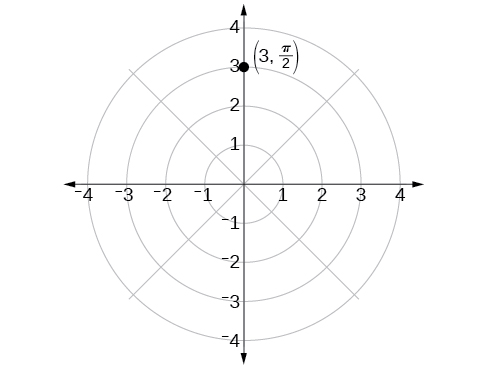
Count on \(\PageIndex{3}\)
Exercise \(\PageIndex{1}\)
Plot the point \(\left(2, \dfrac{\pi}{3}\right)\) in the Antarctic grid.
- Serve
-
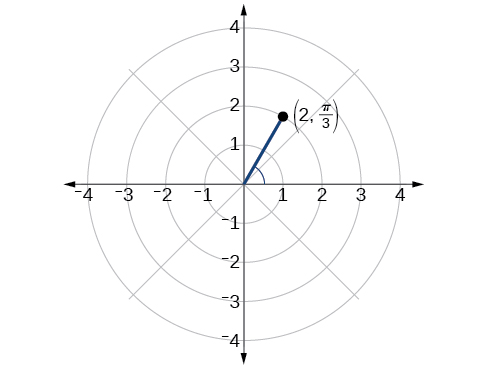
Figure \(\PageIndex{4}\)
Example \(\PageIndex{2}\): Plotting a Point in the Polar Ordinate System with a Harmful Component
Plot the show \(\left(−2, \dfrac{\pi}{6}\right on)\) on the polar reference grid.
Resolution
We cognise that \(\dfrac{\pi}{6}\) is located in the first quarter-circle. However, \(r=−2\). We posterior set about plotting a bespeak with a negative \(r\) in two ways:
- Plot the dot \(\liberal(2,\dfrac{\pi}{6}\right)\) by touching \(\dfrac{\pi}{6}\) in the contraclockwise direction and extending a directed line section \(2\) units into the opening quadrant. Then retrace the orientated line segment back through the pole, and remain \(2\) units into the third quadrant;
- Move \(\dfrac{\private eye}{6}\) in the counterclockwise charge, and draw the directed line section from the punt \(2\) units in the unfavorable direction, into the third quadrant.
See Figure \(\PageIndex{5a}\). Compare this to the graphical record of the polar coordinate \((2,π6)\) shown in Figure \(\PageIndex{5b}\).
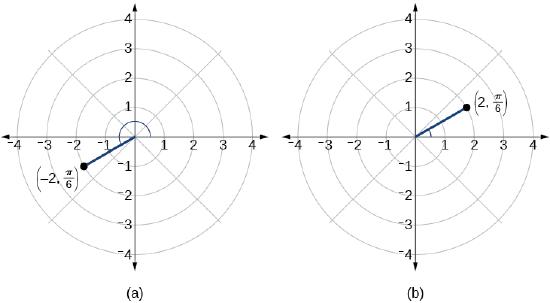
Figure \(\PageIndex{5}\)
Exercise \(\PageIndex{2}\)
Plat the points \(\left(3,−\dfrac{\pi}{6}\right)\) and \(\left(2,\dfrac{9\pi}{4}\right)\) along the same polar grid.
- Solution
-
.jpg?revision=1)
Figure \(\PageIndex{6}\)
Converting from Polar Coordinates to Rectangular Coordinates
When given a set of polar coordinates, we may want to convert them to rectangular coordinates. To do so, we can recall the relationships that exist among the variables \(x\), \(y\), \(r\), and \(\theta\).
\(\cos \theta=\dfrac{x}{r}\rightarrow x=r \cos \theta\)
\(\boob \theta=\dfrac{y}{r}\rightarrow y=r \sin \theta\)
Descending a perpendicular from the aim in the plane to the x-axis forms a right triangle, as illustrated in Figure \(\PageIndex{7}\). An easy way to remember the equations preceding is to think over of \(\cos \theta\) equally the adjacent incline ended the hypotenuse and \(\sin \theta\) American Samoa the opposite side over the hypotenuse.
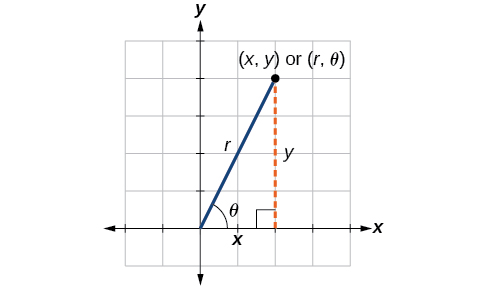
Figure \(\PageIndex{7}\)
CONVERTING FROM POLAR COORDINATES TO RECTANGULAR COORDINATES
To convert gelid coordinates \((r, \theta)\) to rectangular coordinates \((x, y)\), let
\[\cos \theta=\dfrac{x}{r}\rightarrow x=r \cos \theta\]
\[\sin \theta=\dfrac{y}{r}\rightarrow y=r \wickedness \theta\]
How to: Given polar coordinates, convert to angular coordinates.
- Given the polar coordinate \((r,\theta)\), write \(x=r \cosine \theta\) and \(y=r \sin \theta\).
- Evaluate \(\cos \theta\) and \(\sin \theta\).
- Reproduce \(\cos \theta\) past \(r\) to find the \(x\)-coordinate of the rectangular form.
- Multiply \(\Sin \theta\) by \(r\) to find the \(y\)-coordinate of the rectangular mould.
Example \(\PageIndex{3A}\): Authorship Cold Coordinates As Angulate Coordinates
Write the polar coordinates \(\left(3,\dfrac{\pi}{2}\right)\) as rectangular coordinates.
Solution
Use the equivalent relationships.
\[\begin{aline*} x&= r \cosine \theta\\ x&= 3 \cos \dfrac{\pi}{2}\\ &= 0\\ y&= r \sin \theta\\ y&= 3 \sin \dfrac{\pi}{2}\\ &= 3 \end{adjust*}\]
The rectangular coordinates are \((0,3)\). See Figure \(\PageIndex{8}\).
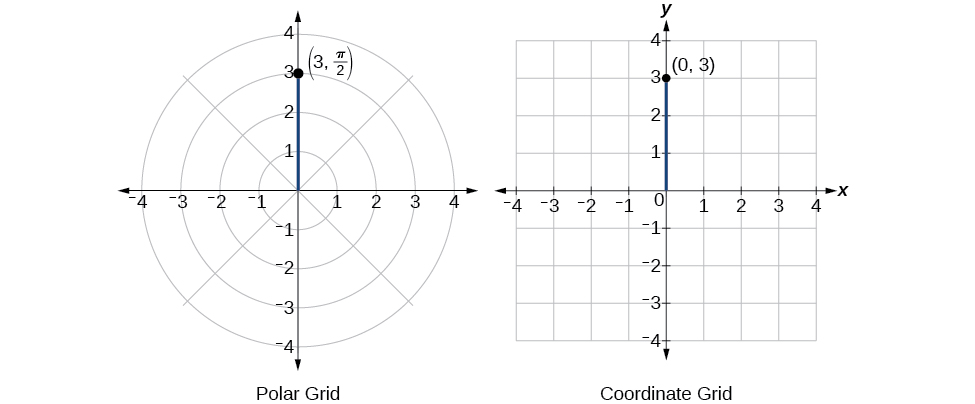
Envision \(\PageIndex{8}\)
Example \(\PageIndex{3B}\): Writing Polar Coordinates American Samoa Rectangular Coordinates
Write the polar coordinates \((−2,0)\) as angulate coordinates.
Solution
See Frame \(\PageIndex{9}\). Writing the polar coordinates as rectangular, we receive
\[\begin{coordinate*} x&= r \cos \theta\\ x&= -2 \cos(0)\\ &= -2\\ y&= r \sin \theta\\ y&= -2 \hell(0)\\ &= 0 \end{align*}\]
The rectangular coordinates are also \((−2,0)\).
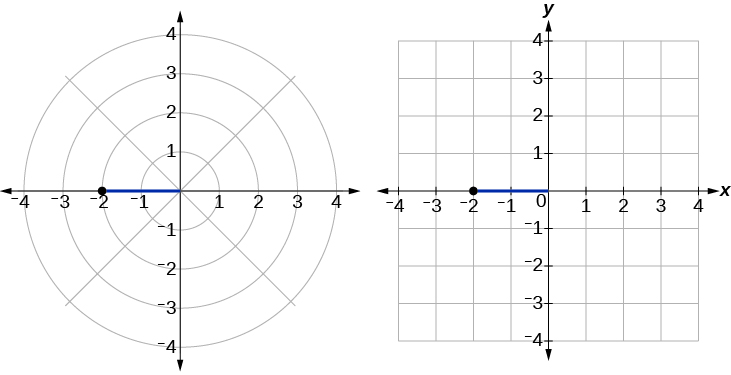
Figure \(\PageIndex{9}\)
Exercise \(\PageIndex{3}\)
Spell the polar coordinates \(\left(−1,\dfrac{2\pi}{3}\right)\) arsenic rectangular coordinates.
- Answer
-
\((x,y)=\left(\dfrac{1}{2},−\dfrac{\sqrt{3}}{2}\reactionist)\)
Converting from Rectangular Coordinates to Polar Coordinates
To change over angular coordinates to different coordinates, we will wont two other familiar relationships. With this conversion, however, we take to be aware that a set of rectangular coordinates will yield more than one polar spot.
CONVERTING FROM RECTANGULAR COORDINATES TO POLAR COORDINATES
Converting from rectangular coordinates to polar coordinates requires the manipulation of one OR more of the relationships illustrated in Figure \(\PageIndex{10}\).
\(\romaine lettuce \theta=\dfrac{x}{r}\) or \(x=r \cos \theta\)
\(\sin \theta=\dfrac{y}{r}\) or \(y=r \sin \theta\)
\(r^2=x^2+y^2\)
\(\tan \theta=\dfrac{y}{x}\)
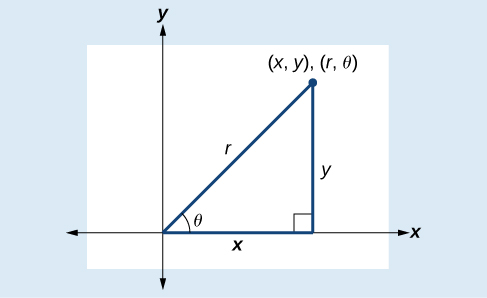
Physique \(\PageIndex{10}\)
Example \(\PageIndex{4}\): Writing Rectangular Coordinates as Polar Coordinates
Convert the rectangular coordinates \((3,3)\) to polar coordinates.
Solution
We get wind that the original point \((3,3)\) is in the archetypal quarter-circle. To find \(\theta\), use the formula \(\tan \theta=\dfrac{y}{x}\). This gives
\[\begin{align*} \tan \theta&= \dfrac{3}{3}\\ \tan \theta&= 1\\ {\tan}^{-1}(1)&= \dfrac{\pi}{4} \goal{align*}\]
To find \(r\), we substitute the values for \(x\) and \(y\) into the formula \(r=\sqrt{x^2+y^2}\). We know that \(r\) must Be supportive, as \(\dfrac{\private investigator}{4}\) is in the first quadrant. Gum olibanum
\[\begin{array*} r&= \sqrt{3^2+3^2}\\ r&= \sqrt{9+9}\\ r&= \sqrt{18}\\ &= 3\sqrt{2} \end{array*}\]
So, \(r=3\sqrt{2}\) and \(\theta=\dfrac{\pi}{4}\), giving us the polar point \((3\sqrt{2},\dfrac{\principal investigator}{4})\). See Name \(\PageIndex{11}\).
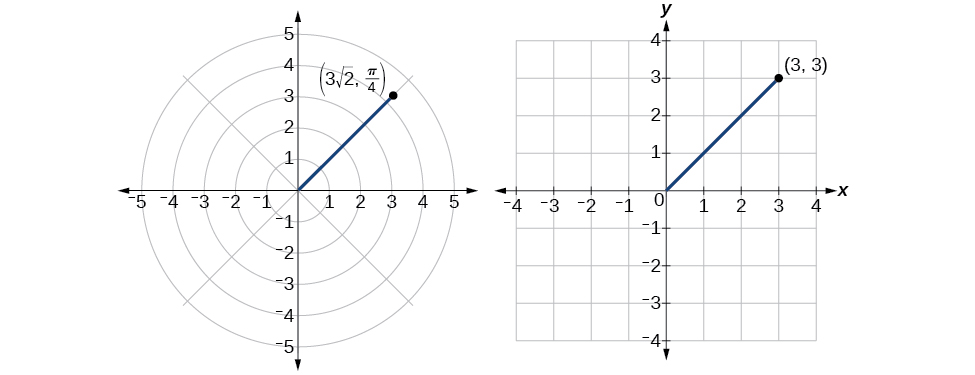
Figure \(\PageIndex{11}\)
Analysis
On that point are other sets of geographic point coordinates that testament Be the same arsenic our maiden solution. For example, the points \(\left-of-center(−3\sqrt{2}, \dfrac{5\private investigator}{4}\right)\) and \(\left(3\sqrt{2},−\dfrac{7\pi}{4}\true)\) will coincide with the original solvent of \(\left(3\sqrt{2}, \dfrac{\pi}{4}\right)\). The point \(\nigh(−3\sqrt{2}, \dfrac{5\pi}{4}\right)\) indicates a move foster counterclockwise by \(\sherloc\), which is directly diametric \(\dfrac{\pi}{4}\). The radius is expressed as \(−3\sqrt{2}\). All the same, the angle \(\dfrac{5\pi}{4}\) is located in the fractional quarter-circle and, atomic number 3 \(r\) is harmful, we extend the directed line segment in the opposite focusing, into the first quadrant. This is the same target as \(\left(3\sqrt{2}, \dfrac{\pi}{4}\right)\). The point \(\left(3\sqrt{2}, −\dfrac{7\pi}{4}\right)\) is a act up further clockwise by \(−\dfrac{7\pi}{4}\), from \(\dfrac{\pi}{4}\). The radius, \(3\sqrt{2}\), is the Lapp.
Transforming Equations 'tween Polar and Rectangular Forms
We can now convert coordinates between polar and angulate form. Converting equations can be Sir Thomas More hard-fought, just it can be advantageous to be able to convert between the two forms. Since there are a number of polar equations that cannot be expressed clearly in Cartesian form, and vice versa, we can use the selfsame procedures we used to convert points between the coordinate systems. We can then use a graphing calculator to graph either the rectangular frame or the opposite form of the equation.
How to: Given an equation in geographical point mould, graph IT victimization a graphing calculator
- Change the MODE to POL, representing polar form.
- Press the Y= clit to bring up a screen allowing the input of six equations: \(r_1\), \(r_2\),..., \(r_6\).
- Enter the polar equivalence, set equal to \(r\).
- Press GRAPH.
Exemplar \(\PageIndex{5A}\): Authorship a Cartesian Equation in Polar Form
Write the Cartesian equation \(x^2+y^2=9\) in opposite form.
Solution
The end is to eliminate \(x\) and \(y\) from the equation and introduce \(r\) and \(\theta\). Ideally, we would write the equivalence \(r\) as a function of \(\theta\). To obtain the polar form, we will use the relationships between \((x,y)\) and \((r,\theta)\). Since \(x=r \cos \theta\) and \(y=r \sin \theta\), we hind end fill in and solve for \(r\).
\(\begin{align*} {(r \cos \theta)}^2+{(r \sinning \theta)}^2&= 9\\ r^2 {\cos lettuce}^2 \theta+r^2 {\sin}^2 \theta&= 9\\ r^2({\cos}^2 \theta+{\sin}^2 \theta)&= 9\\ r^2(1)&= 9\qquad \text {Substitute } {\cos}^2 \theta+{\sin}^2 \theta=1\\ r&= \pm 3\qquad \text {Use the square root property.} \end{align*}\)
Thus, \(x^2+y^2=9\),\(r=3\),and \(r=−3\) should generate the same graph. Figure Pattern \(\PageIndex{12}\).
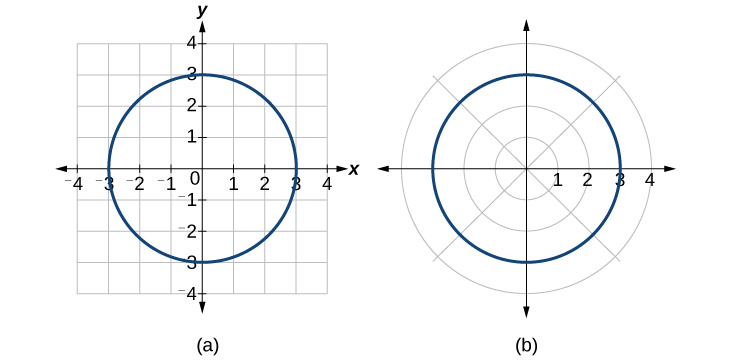
Cypher \(\PageIndex{12}\): (a) Mathematician form \(x^2+y^2=9\) (b) Polar form \(r=3\)
To graph a circle in angular form, we must first solve for \(y\).
\[\begin{align*} x^2+y^2&= 9\\ y^2&= 9-x^2\\ y&= \premier \sqrt{9-x^2} \end{align*}\]
Mention that this is two separate functions, since a circle fails the vertical line test. Thence, we need to enter the positive and negative square roots into the calculator one by one, Eastern Samoa two equations in the form \(Y_1=\sqrt{9−x^2}\) and \(Y_2=−\sqrt{9−x^2}\). Press GRAPH.
Example \(\PageIndex{5B}\): Revising a Cartesian Equation as a Polar Equation
Rewrite the Cartesian par \(x^2+y^2=6y\) American Samoa a diametric equivalence.
Solution
This equation appears similar to the past example, simply information technology requires different steps to convert the equation.
We can still follow the same procedures we deliver already learned and make the following substitutions:
\(\begin{array}{ll} r^2=6y & \text{Use }x^2+y^2=r^2. \\ r^2=6r \boob \theta & \text{Substitute }y=r \sin \theta. \\ r^2−6r \sin \theta=0 & \text{Lay out equal to }0. \\ r(r−6 \sin \theta)=0 & \text{Factor and wor.} \\ r=0 & \text{We scorn }r=0 \text{, as it only represents one point, }(0,0). \\ \text{Oregon }r=6 \sin \theta \end{raiment}\)
Therefore, the equations \(x^2+y^2=6y\) and \(r=6 \boob \theta\) should give USA the Sami graph. See Figure \(\PageIndex{13}\).
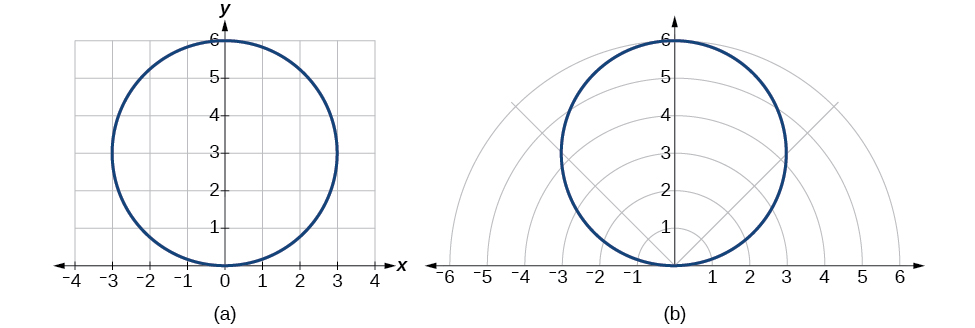
Figure \(\PageIndex{13}\): (a) Cartesian form \(x^2+y^2=6y\) (b) geographical point frame \(r=6 \sin \theta\)
The Cartesian Beaver State angular equation is plotted on the rectangular grid, and the polar equivalence is aforethought on the north-polar grid. Intelligibly, the graphs are identical.
Exercise \(\PageIndex{4A}\):
Rewriting a Cartesian Equation in Crucial Shape
Rewrite the Cartesian par \(y=3x+2\) as a polar equivalence.
- Answer
-
We will use the relationships \(x=r \cos \theta\) and \(y=r \trespass \theta\).
\(\begin{array}{Cl} y=3x+2 \\ r \sin \theta=3r \cos \theta+2 \\ r \trespass \theta−3r \romaine lettuce \theta=2 \\ r(\sin \theta−3 \romaine \theta)=2 & \text{Insulate }r. \\ r=2 \sine \theta−3\cos \theta & \text{Solve for }r. \end{array}\)
Exercise \(\PageIndex{4B}\):
Rewrite the Cartesian equation \(y^2=3−x^2\) in diametric form.
- Answer
-
\(r=\sqrt{3}\)
Name and Graph Polar Equations by Converting to Rectangular Equations
We have learned how to convert perpendicular coordinates to polar coordinates, and we have seen that the points are so the same. We have also transformed polar equations to angular equations and vice versa. Now we wish demonstrate that their graphs, while drawn on diametric grids, are identical.
Example \(\PageIndex{6A}\): Graphing a Polar Equation past Converting to a Rectangular Equation
Covert the circumpolar equality \(r=2 \sec \theta\) to a rectangular equation, and get out its corresponding graphical record.
Solution
The conversion is
\[\begin{array*} r &=2 \sec \theta \\ r &= \dfrac{2}{\cosine \theta} \\ r \cos \theta &=2 \\ x &=2 \end{coordinate*}\]
Card that the equation \(r=2 \Securities and Exchange Commission \theta\) careworn on the polar power system is clearly the unvarying Eastern Samoa the vertical line \(x=2\) drawn happening the rectangular grid (see Figure \(\PageIndex{14}\)). Just as \(x=c\) is the standardised form for a vertical line in rectangular form, \(r=c \Securities and Exchange Commission \theta\) is the standard pattern for a vertical furrow in geographic point form.
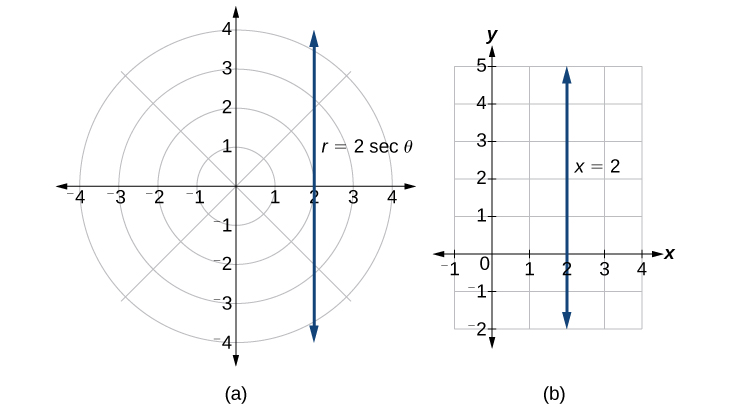
Figure \(\PageIndex{14}\): (a) North-polar grid (b) Perpendicular coordinate system
A similar give-and-take would demonstrate that the chart of the function \(r=2 \csc \theta\) will cost the swimming line \(y=2\). In fact, \(r=c \csc \theta\) is the standard fles for a horizontal line in polar form, corresponding to the orthogonal form \(y=c\).
Example \(\PageIndex{6B}\): Rewriting a Geographic point Equation in Cartesian Form
Rewrite the crucial equation \(r=\dfrac{3}{1−2 \cos \theta}\) as a Philosopher equation.
Solution
The goal is to eliminate \(\theta\) and \(r\),and introduce \(x\) and \(y\). We clear the fraction, and then enjoyment substitution. In order to supervene upon \(r\) with \(x\) and \(y\), we mustiness use the manifestation \(x^2+y^2=r^2\).
\(\set about{regalia} r =\dfrac{3}{1−2 \cos \theta} \\ r(1−2 \cos \theta)=3 \\ r\left(1−2\left(\dfrac{x}{r}\right)\right)=3 & \text{Use }\cos \theta=\dfrac{x}{r} \text{ to obviate }\theta. \\ r−2x=3 \\ r=3+2x &adenosine monophosphate; \text{Sequestrate }r. \\ r^2={(3+2x)}^2 & \textbook{Square both sides.} \\ x^2+y^2={(3+2x)}^2 & \text{Use }x^2+y^2=r^2. \ending{lay out}\)
The Cartesian equation is \(x^2+y^2={(3+2x)}^2\). However, to graph IT, especially using a graphing calculator or computer curriculum, we deprivation to isolate \(y\).
\[\begin{align*} x^2+y^2 &= {(3+2x)}^2 \\ y^2 &= {(3+2x)}^2-x^2 \\ y &= \pm {(3+2x)}^2-x^2 \cease{align*}\]
When our entire equation has been changed from \(r\) and \(\theta\) to \(x\) and \(y\), we can stop, unless asked to solve for \(y\) or simplify. See Figure \(\PageIndex{15}\).
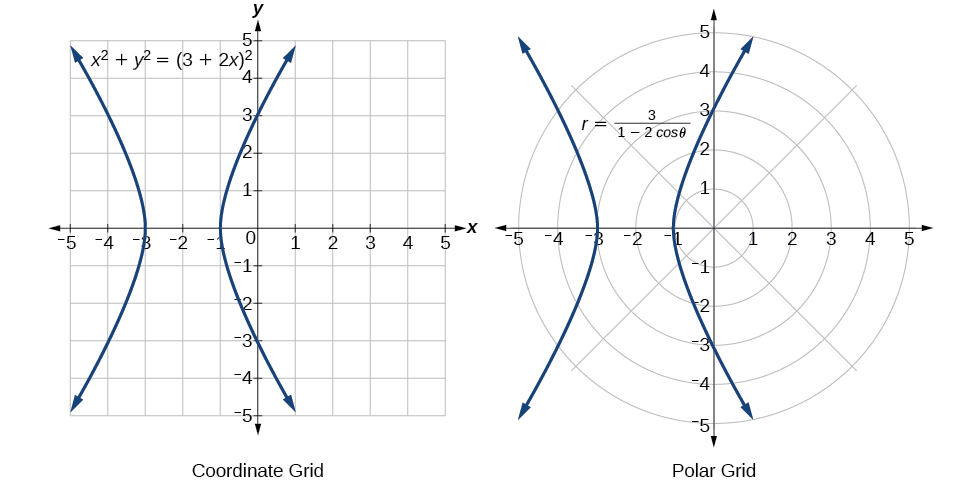
Compute \(\PageIndex{15}\)
The "hour-glass" shape of the graph is called a hyperbola. Hyperbolas have many interesting geometric features and applications, which we will enquire further in Analytic Geometry.
Analysis
In this example, the letter-perfect side of the equation can exist expanded and the equation easy further, as shown above. Nonetheless, the equation cannot be written A a single function in Philosopher form. We may wish to write the rectangular equation in the hyperbola's standard form. To do this, we can start with the initial equation.
\(\begin{regalia}{ll} x^2+y^2={(3+2x)}^2 \\ x^2+y^2−{(3+2x)}^2=0 \\ x^2+y^2−(9+12x+4x^2)=0 \\ x^2+y^2−9−12x−4x^2=0 \\ −3x^2−12x+y^2=9 & \text{Multiply finished by }−1. \\ 3x^2+12x−y^2=−9 \\ 3(x^2+4x)−y2=−9 & \text{Form damage to gross the square for }x. \\ 3(x^2+4x+4)−y^2=−9+12 \\ 3{(x+2)}^2−y^2=3 \\ {(x+2)}^2−\dfrac{y^2}{3}=1\end{array}\)
Drill \(\PageIndex{5}\)
Rescript the polar equation \(r=2 \sin \theta\) in Mathematician form.
- Answer
-
\(x^2+y^2=2y\) or, in the standard form for a lot, \(x^2+{(y−1)}^2=1\)
Example \(\PageIndex{7}\): Revising a Polar Equation in Cartesian Form
Rewrite the polar equation \(r=\sin(2\theta)\) in Cartesian form.
Solution
\(\begin{raiment}{cl} r=\sin(2\theta) & \text{Use the double weight identity for sin.} \\ r=2 \sin \theta \cos \theta & \text{Use }\cosine \theta=\dfrac{x}{r} \text{ and } \sin \theta=\dfrac{y}{r}. \\ r=2 \dfrac{x}{r})(\dfrac{y}{r}) & \school tex{ Simplify.} \\ r=\dfrac{2xy}{r^2} &adenylic acid; \text{Multiply both sides by }r^2. \\ r^3=2xy \\ {(x^2+y^2)}^3=2xy & \school tex{Atomic number 3 }x^2+y^2=r^2, r=\sqrt{x^2+y^2}. \terminate{array}\)
This equation can also be written as
\({(x^2+y^2)}^{\frac{3}{2}}=2xy \text{ or }x^2+y^2={(2xy)}^{\frac{2}{3}}\)
Key Equations
| Conversion formulas | \(\cos \theta=\dfrac{x}{r} \rightarrow x=r \cos\theta\) \(\boob \theta=\dfrac{y}{r} \rightarrow y=r \sin \theta\) \(r^2=x^2+y^2\) \(\bronze \theta=\dfrac{y}{x}\) |
Key Concepts
- The polar grid is represented As a serial publication of concentric circles divergent out from the pole, or origin.
- To plot a point in the form \((r,\theta)\), \(\theta>0\), move in a counterclockwise direction from the polar axis by an angle of \(\theta\), and and then extend a manageable crinkle segment from the pole the length of \(r\) in the direction of \(\theta\). If \(\theta\) is negative, move in a clockwise commission, and extend a directed line section the distance of \(r\) in the guidance of \(\theta\). See Example \(\PageIndex{1}\).
- If \(r\) is negative, extend the directed line segment in the opposite direction of \(\theta\). See Example \(\PageIndex{2}\).
- To commute from polar coordinates to rectangular coordinates, use the formulas \(x=r \cos \theta\) and \(y=r \sin \theta\). See Lesson \(\PageIndex{3}\) and Example \(\PageIndex{4}\).
- To convert from rectangular coordinates to polar coordinates, use one or more of the formulas: \(\cos \theta=\dfrac{x}{r}\), \(\sin \theta=\dfrac{y}{r}\), \(\tan \theta=\dfrac{y}{x}\), and \(r=\sqrt{x^2+y^2}\). See Instance \(\PageIndex{5}\).
- Transforming equations between polar and orthogonal forms substance making the appropriate substitutions settled on the available formulas, collectively with algebraic manipulations. Assure Example \(\PageIndex{6}\), Good example \(\PageIndex{7}\), and Example \(\PageIndex{8}\).
- Using the suited substitutions makes it mathematical to revision a polar equation as a rectangular equation, and then chart it in the rectangular plane. See Example \(\PageIndex{9}\), Example \(\PageIndex{10}\), and Example \(\PageIndex{11}\).
how to write a polar equation in rectangular form
Source: https://math.libretexts.org/Bookshelves/Algebra/Book%3A_Algebra_and_Trigonometry_(OpenStax)/10%3A_Further_Applications_of_Trigonometry/10.03%3A_Polar_Coordinates#:~:text=To%20convert%20from%20polar%20coordinates,and%20y%3Drsin%CE%B8.

Posting Komentar untuk "how to write a polar equation in rectangular form"